
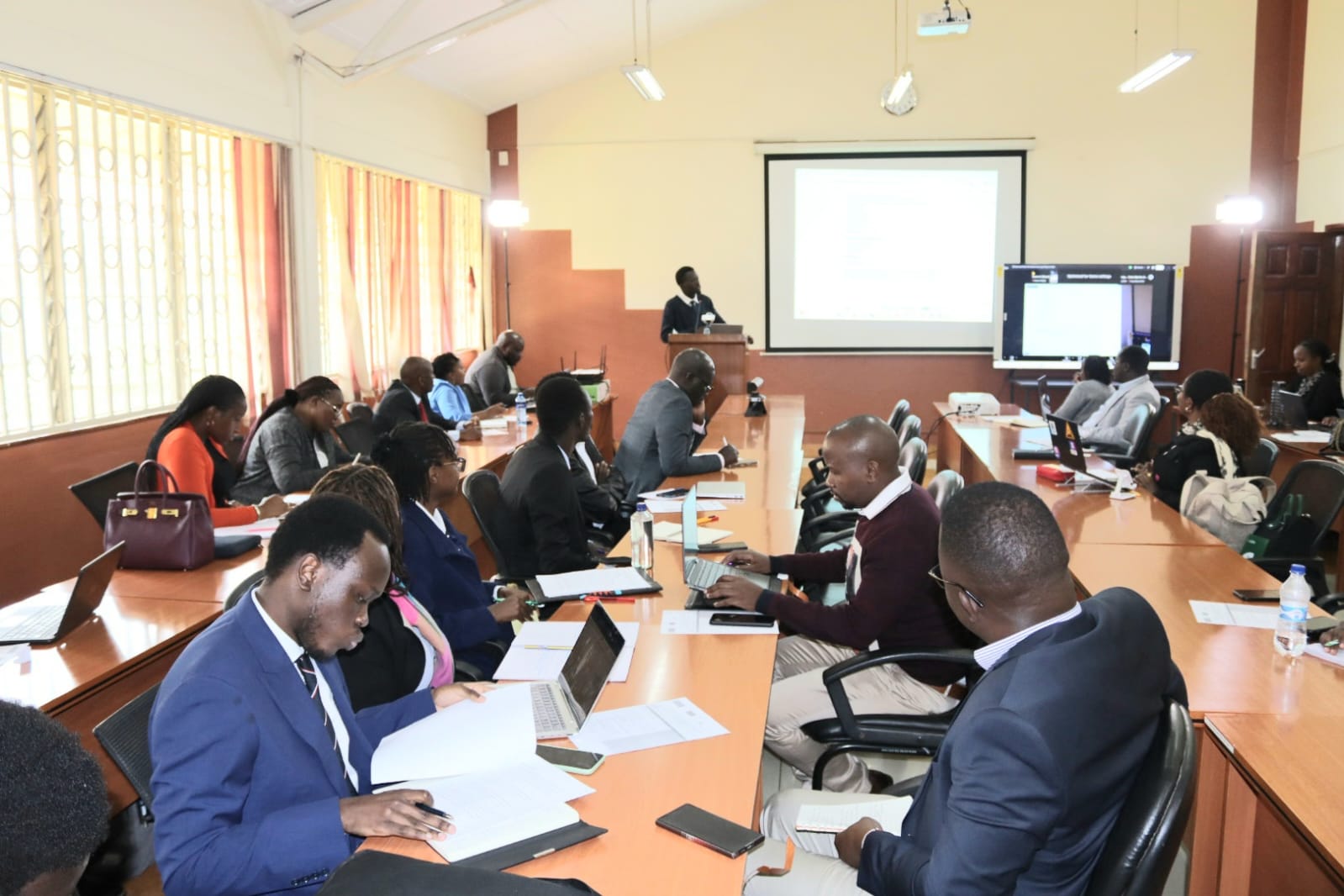
Sixteen undergraduate law students from the University of Nairobi have successfully completed the Amboseli Socio-Legal Regime Research Project, a major field study examining the intersection of land governance, conservation, and access to justice. The findings were unveiled on Tuesday, 3rd March 2026; during the 5th Brown Bag Symposium at the Faculty of Law, marking a milestone for the institution’s student-led research initiatives. The project operates under the broader Digital Land Governance Programme aimed at fostering evidence-led research and experiential learning with support the Food and Agriculture Organization and the European Union.
The student researchers conducted fieldwork in the Amboseli ecosystem between August 27 and September 1, 2025. During the visit, the team engaged residents, local administrators, conservation actors and Civil Society Organizations to understand how legal frameworks operate in practice. The research culminated in a comprehensive report and a documentary titled “When Land Meets Life: The Story of Amboseli,” which screened during the symposium. The documentary captures community voices and provides a visual account of the complex relationship between land ownership and pastoralist livelihoods. Opening the session, Prof. Collins Odote praised the student-led model, noting that the student researchers successfully translated complex legal theories into lived realities, “proving that law must serve both people and the planet.”
Project Director, Oswin Trevor outlined the study’s three thematic pillars: land and conservation governance, access to justice, and climate sustainability. Thematic leads presented policy briefs highlighting key findings regarding: Land tenure transitions and ecosystem integrity, Conservation & community benefit-sharing and Carbon governance, transparency & verification.
Presenting her policy brief, student researcher Ms. Tiffany Muthiora warned of a disconnect between policy and practice. “Conservation policies cannot succeed if they ignore the mobility patterns and land practices of pastoralist communities,” she argued. “True sustainability requires meaningful participation by the communities who live in these landscapes.”
The study also identified a "persistent justice gap." Student researcher Mr. Don Ruto noted that financial constraints and complex legal procedures often prevent local communities from resolving land disputes or negotiating fair carbon-related agreements. This concern was echoed by Mr. Ayaga Max, who focused on the burgeoning carbon market. “As carbon markets expand, questions of ownership and transparency become critical,” he said. “Without clear legal frameworks, there is a risk that revenues from carbon initiatives may not reach local communities.”
A high-level panel, moderated by Prof. Robert Kibugi responded to the student presentations. Dr. Celestine Musembi, Chair of the Department of Environmental and International Law, interrogated the shift from communal to private land tenure. Moko Nche, a representative from the Amboseli community, delivered a pointed observation: "There is no community land as defined in the law. We are moving from a community land management regime to a private land management regime. The question is how benefits will be shared."
Ms. Joycelyn Makena Kaaria of the Kenya Wildlife Service highlighted the administrative hurdles, noting that "coordination between local and national government is fragmented," while Dr. Mwenda Makathimo challenged the economic transparency of green energy projects. "Do we know the actual cost of these carbon credits? What valuation methods are being used?" he asked, calling for more robust quasi-judicial mechanisms for dispute resolution.
As Kenya navigates complex negotiations around carbon regulation and community land rights, these findings are positioned to feed directly into national policy. The Story of Amboseli project has set a new precedent for the Faculty of Law: the ambition now is to deepen that pipeline by translating student-led field research into policy briefs, legislative proposals and frameworks that place communities at the center of Kenya's environmental future. The Amboseli project has set a precedent.

