

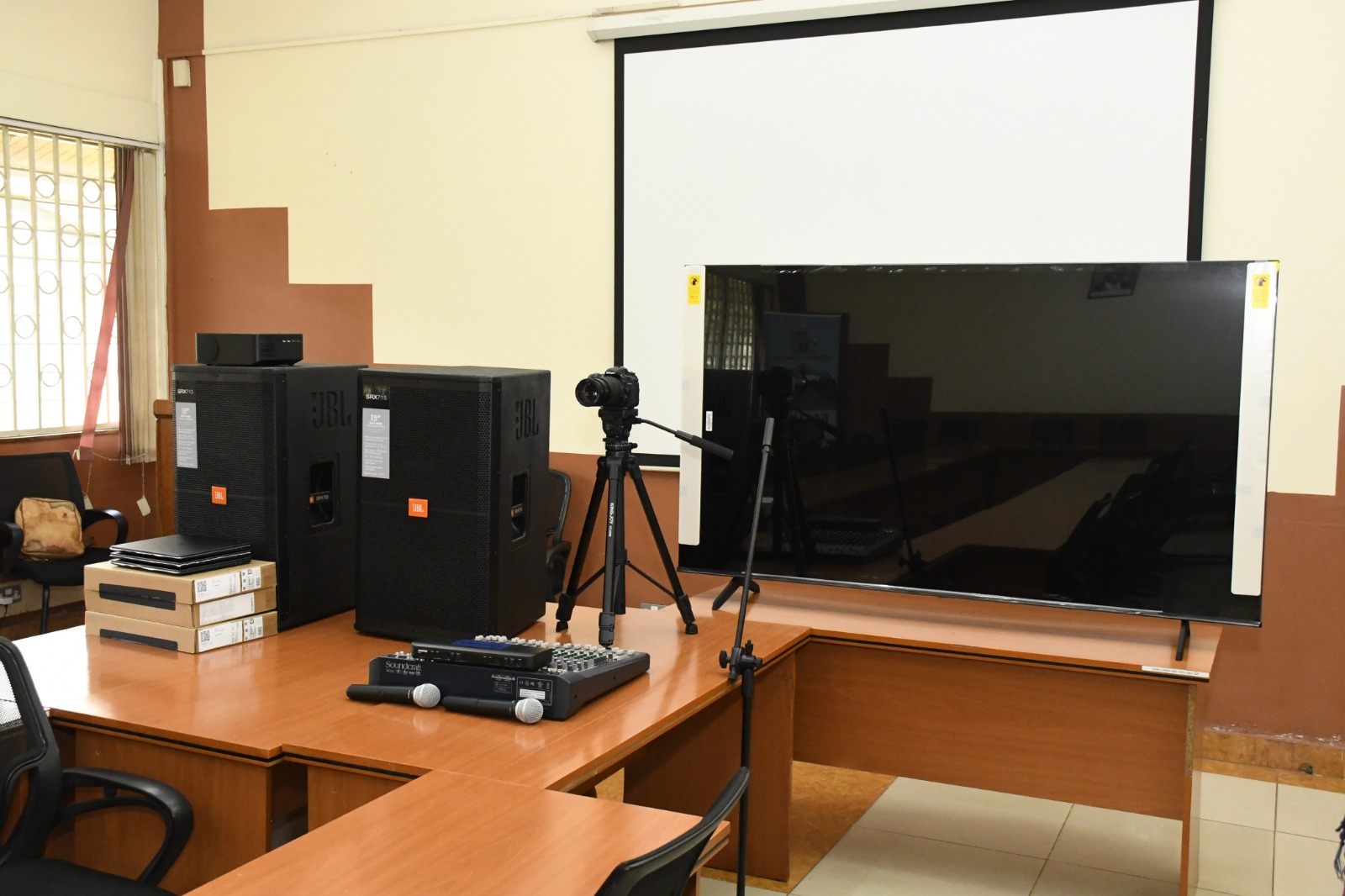
The Faculty of Law witnessed a significant milestone on August 11, 2025, as the Food and Agriculture Organization (FAO) officially handed over essential equipment- 3 laptops, a digital screen, projector, sound system & camera to support the groundbreaking project "Fostering Thought Leadership and Evidence-Led Research for Sustainable Land Governance in Kenya." The ceremony, held at the Prof. Okoth-Ogendo Boardroom, marked a deepening partnership between international organizations and Kenyan academia in addressing critical land governance challenges.
Professor Collins Odote, Associate Dean and Project Leader, emphasized the strategic importance of this initiative within the broader Digital Land Governance Programme supported by the European Union and the University of Nairobi. The project represents a comprehensive approach to establishing evidence-based networks that can inform policy and drive sustainable land management practices across Kenya and beyond.
"This project is part of a series of researches on academic networks, focusing on how to create meaningful connections and generate the kind of information that can transform land governance," Professor Odote explained. The initiative encompasses multiple activities including establishing a land governance pipeline, undertaking strategic research collaborations with institutions like the University of Waterloo and partnerships with the National Government of Côte d'Ivoire, while building capacity through the African Humanities Study Centre.
The programme has already demonstrated remarkable impact through monthly critical discussions on land governance issues, addressing everything from housing implications to violence prevention in land-related conflicts. The faculty is simultaneously developing a five-year curriculum enhancement plan to ensure undergraduate and postgraduate programmes remain relevant and responsive to emerging challenges in land governance.
Husna Mbarak, FAO Land Programme Manager, highlighted the transformational potential of this partnership, noting that it extends far beyond a simple equipment donation. "This partnership creates a platform where we can recognize the work that universities do, and most importantly, how we bring all that research done by students and staff into practical policy implementation," she stated.
Mbarak emphasized that the collaboration addresses a critical gap identified in previous assessments, where valuable research often remained confined to academic circles without informing policy processes. The partnership aims to create pathways for research findings to influence sustainable land governance policies, ensuring that academic work translates into real-world solutions.
"We see the University of Nairobi as a model and the center of these data processes," Mbarak continued. "The think tank established through this project has already gained recognition, with former government officials acknowledging its potential to inform better policy decisions. This represents a sustainable movement that will continue beyond the programme period."
Dr. Nyabenyi Tipo, FAO Country Representative, placed the initiative within the broader context of global technological advancement and innovation. "The world is changing rapidly with developments in innovation and AI," Dr. Tipo observed. "Having these systems in place means that the university is actually catching up with global progress and trends."
Dr. Tipo, who has been working as Tanzania's director for the past year providing impact assistance, expressed enthusiasm about the equipment's potential to enhance research capabilities. "Whether it's research, demographic studies, or laboratory work, if it has impact, it's a very beneficial and important step for the country," she noted, emphasizing the collaborative learning approach that characterizes the partnership.
The donated equipment, including three laptops, a digital screen, projector, sound system, and camera, will revolutionize both pedagogy and research capacities within the faculty. In his keynote address representing the Vice-Chancellor, Professor Jackson Maalu, Deputy Vice-Chancellor for Finance, Planning and Development, described the donation as "an investment in ideas, human capital, and the transformation of our society."
"Land remains one of Kenya's most significant assets, underpinning our economic stability, cultural heritage, and social cohesion," the Vice-Chancellor stated through Professor Maalu. "However, it presents persistent challenges related to ownership, utilization, dispute resolution, and access. The Land Governance Project within our Faculty of Law is a strategic response to these complexities."
Dean Winifred Kamau of the Faculty of Law emphasized the university's commitment to innovative and impactful research, noting that the partnership has already yielded substantial results. "We have successfully hosted three brown-bag symposia, a joint conference with the Law Society of Kenya, a research fair, and a public lecture in honour of Professor Okoth-Ogendo," she reported.
The faculty has established a dedicated think tank focused on strengthening research, policymaking, and policy direction in land administration, land use planning, and conflict resolution. Additionally, work is progressing on developing a comprehensive handbook to support university-level land governance education.
Professor Kamau highlighted the project's success in promoting inclusivity by engaging diverse stakeholders, including students, faculty, partner universities, government agencies, NGOs, civil society organizations, and private sector entities. This multi-stakeholder approach ensures that research findings reflect diverse perspectives and can be effectively implemented across different sectors.
The ceremony represented more than just an equipment handover; it symbolized a commitment to transforming how land governance challenges are addressed in Kenya. Speaking on behalf of the Vice-Chancellor, Professor Maalu emphasized that this partnership model demonstrates how international organizations and academic institutions can collaborate effectively to create sustainable solutions to complex societal problems.
The project's emphasis on evidence-based research and policy dialogue positions the University of Nairobi's Faculty of Law as a leading voice in land governance discourse. By providing students and faculty with enhanced technological capabilities, the donation ensures that future legal scholars and practitioners will be equipped to tackle emerging challenges in land management, environmental sustainability, and social justice.
As Kenya continues to grapple with complex land-related issues affecting food security, economic development, and social stability, this partnership provides a crucial foundation for generating innovative solutions. The combination of international support, academic expertise, and cutting-edge equipment creates an environment where research can flourish and translate into meaningful policy change.
The success of this initiative serves as a model for how academic-practitioner partnerships can drive sustainable development. By bridging the gap between research and policy implementation, the programme ensures that valuable academic insights reach decision-makers and communities who can benefit from evidence-based approaches to land governance.
Moving forward, the partnership promises to strengthen Kenya's capacity for addressing land governance challenges while contributing to broader regional and global discussions on sustainable land management. The equipment donation marks just the beginning of what participants hope will be a long-term collaboration that continues to generate innovative solutions and build institutional capacity for years to come.

